Why Whales? – Japanese Whale Hunting

Figure 1: The body of a whale being taken aboard a Japanese vessel
Source: https://www.ft.com/__origami/service/image/v2/images/raw/https%3A//s3-ap-northeast-1.amazonaws.com/psh-ex-ftnikkei-3937bb4/images/4/2/8/5/15735824-2-eng-GB/20180914N%20Whaling.jpg?source=nar-cms

A recent statement from the Japanese government declares that Japan are planning to resume their whaling operations in the Antarctic, despite the criticism they receive. The decision to continue the hunting and slaughtering of whales in the Antarctic every winter season is certainly going to anger nations that adopt an anti-whaling viewpoint. Resulting from the controversial nature of whale hunting, there is a large presence of anti-whaling activists that operate to prevent the actions of Japanese whale hunters. Australia’s government have been the most outspoken in their distaste of Japan’s decision to continue their whaling operations, stating “Australia is opposed to all forms of commercial and so-called ‘scientific’ whaling”

Why Continue?

Keiko Hirata explains that Japan have consistently and aggressively lobbied the International Whaling Commission (IWC) for a resumption of commercial whaling. Understandably, this has frequently caused many Western governments to believe that Japan is obstructing international efforts to protect endangered whale species. The most prevalent question surrounding the topic is: why continue to hunt if the average yearly consumption of whale meat by the Japanese population is 30g per person?

When attempting to explain their justification for continuing whaling, despite it being irrelevant to feeding the population, the Japanese government highlights the cultural link to whale hunting (see figure 2). There are a number of coastal communities that have hunted whales for centuries, making them infamous for their annual hunts. Whilst there’s an ancient cultural association with the Japanese and whaling, Danaher suggests that attention and open disagreement from the public can largely influence government decision regarding the capture of whales outside of hunting season. 

Figure 2: Image depicting the traditional whaling undertaken by the Japanese
Source: https://aasujournalofhistory.wordpress.com/2011/03/17/the-superwhale-myth-the-motivations-of-the-japanese-governments-pro-whaling-policy/

When Does it Become Detrimental?

One of the biggest concerns raised by whaling efforts from the Japanese revolves around endangered whale species. It can be argued that whaling ensures the management of whale populations in certain locations where there could be an abundance of a species, lowering the biodiversity of the ecosystem. A counter argument to this relies on the classification of an endangered species taking into account global populations, meaning the Japanese can justify their whaling operations in the Antarctic due to Minke whales being found across the globe, meaning they are not at risk of imminent extinction. This is a worrying counter argument because if whaling in the Antarctic is not restricted and managed in conjunction with other populations, the global whale species count could be at risk of being unsustainably depleted. 

The Future of Japanese Whaling

The operation of whaling in Japan is a long-standing tradition which, although heavily contested, is likely to continue for the foreseeable future. The point at which this becomes a significant issue is when whale populations are being depleted unsustainably. A possible solution to this is an increase in the monitoring of Japanese whaling, to ensure they are not exceeding current quotas imposed on their operations.

Plastic Pollution – ‘Out of Sight, Out of Mind’?

Plastic pollution is known as the biggest human induced threat to the world’s seas, with an estimated 8 million tons being swept into the seas each year.  If this issue is so ubiquitous, why are we, as a global population, still continuing to incorrectly dispose of our plastic waste? Copious amounts of literature suggests that unless there is a dramatic decrease in the amount of plastic produced and discarded by humans, then ocean plastic pollution is set to treble in the next decade.

Figure 1: Marine Plastic Pollution
Source: http://cdn1.theinertia.com/wp-content/uploads/2015/05/2RaceforWater_Pollution_ChristopheLaunay.jpg

Statistics released by the British Government Environmental Audit Committee should not come as a huge surprise to most people. The ‘out of sight, out of mind’ attitude is commonly employed by a significant proportion of the population who do not wish to address the issues that our planet is facing. Whilst this make work for some people, MPs have urged that that this is not the case for ocean pollution. This growing threat of plastic pollution should be spurring the population to take a more active approach to reducing the threat; but people continue to turn a blind eye to the issue, demonstrated through the online depiction of seas and coastal areas. 

Online Depiction of the Sea 

Photographs posted by tourists and travellers rarely show the plastic pollution that plagues the worlds seas and coastlines. There is an overwhelming social pressure to photograph and share images of the ‘beautiful’ coastal landscapes that exist across the globe. However, these images, particularly of the sea, are often tailored to project an idea of large expanses of bright-blue and pristine water; not the reality which is often floating plastic and filthy waters. The comparison of two pictures posted on Instagram after being taken at Juhu Beach in Mumbai, India, perfectly illustrates this point. Juhu Beach in Mumbai is known to be one of the most popular and famous beaches in India; a title which attracts many tourists, who will in turn take photographs of the area and post them online. 

Figure 2: Image showing the reality of Juhu Beach, Mumbai
Source: https://www.instagram.com/p/Bt_Px8glIVh/?utm_source=ig_share_sheet&igshid=1pnmlhcd3q36e
Figure 3: An image taken at Juhu Beach, Mumbai
Source: https://www.instagram.com/p/BsP_zR9hicf/?utm_source=ig_share_sheet&igshid=144t7t3870rqt

These two images show the same beach but contain contrasting messages. Figure 2 has been taken to demonstrate the reality that we as a population must face; that our seas and subsequently our beaches are covered in our plastic waste. Images like this are not commonly shared in the public domain by visitors, due to the pressure to portray a ‘perfect’ landscape. In comparison, figure 3 accentuates the sunset and vast blue waters that extend off the coast of Mumbai; not a piece of plastic waste in sight. This type of photograph is most common and can provide an accurate summary of the way in which beaches and the sea are presented on a daily basis.

This contrast in photographic depiction of the sea highlights the ignorance towards the impact we are having on our seas which resides in the attitudes of a significant proportion of the world’s population.

The South China Sea – Creation and Contestation

Seas are, on the surface, vast expanses of water separating countries and continents, however they present a platform for politically charged operations and are highly contested spaces.

Ongoing Disputes

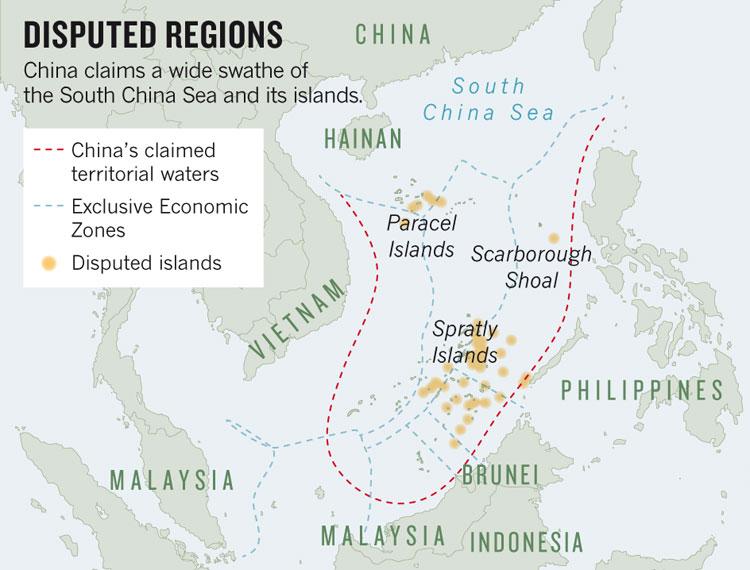
Territorial disputes over the South China Sea (SCS) have existed since the 1950s when the China was claimed by the communist party of China and the nine-dash line was implemented as a way of claiming the sea. This line, shown in figure 1, ignores the legal territorial claims of other countries in the region.

Figure 1:
Source: http://media.philstar.com/images/the-philippine-star/world/20140911/Nine-dashed-line-South-China-Sea.jpg

Whilst attempting to assert dominance in the SCS, China have been transforming low-lying reefs, which are commonly underwater during high-tide, into permanent islands(see figure 2). Storey explainsthat the first indication of this came with the discovery of Chinese-built structures on Mischief Reef, which resides well with the Philippine-claimed 200 nautical-mile Exclusive Economic Zone. This creation of islands in sea that doesn’t fall under the territorial ownership of China is leading to an increase in the militarisation of the SCS, with the country pushing its defences beyond their coast in a seemingly ‘aggressive’ manner.

Figure 2: Before and After – The Creation of a Man-made Island in the SCS
Source: http://cdn.static-economist.com/sites/default/files/images/print-edition/20150502_CNP004_1.jpg

British Involvement

According to international law, any country can exercise their right to travel in and over international waters, without facing any contestation due to the ‘freedom of navigation’ clause.

Due to recent identification of China’s attempt to claim not only these international waters, but the waters of other nations, the British have been exercising their shared right to the sea space by both flying their military aircraft over and deploying naval warships to exercise in the region. Whilst it can be argued that this exercising of power is an essential action to make in order to prevent China from aggressively claiming the contested sea space, is this simply Britain attempting to ‘flex’ their power in an unnecessary manner? This idea of ‘muscle-flexing’ highlights the assumed masculinity of sea politics and governance.

Whilst Britain could be seen by the Chinese government to be asserting power in a way that was not necessary, the dependency of the relationship between the two countries is too significant to risk compromising. China needs access to British technological markets and Britain rely on China for manufacturing and exports. The nature of recent encounters between the HMS Albion (see figure 3) and the Chinese navy must be navigated carefully as they come at delicate time due to London-Beijing negotiationsover securing a free-trade deal in a post-Brexit situation. Tense encounters between British and Chinese naval boats are likely to continue, heightening the militarisation of the sea space. 

Figure 3: The HMS Albion exercising its right to navigate the waters of the SCS
Source: https://www.telegraph.co.uk/content/dam/news/2018/09/06/TELEMMGLPICT000160044997_trans_NvBQzQNjv4BqufPWexoDNO0wvV3FQMbBIAMLDcm08fJADSTQTckqLY4.jpeg?imwidth=450

The Imminent Future

The assertion of dominance by China through the building man-made islands in regions of the SCS are a cause for concern for many countries across the globe as the sea becomes a focal point for ‘big power rivalry’. The persistence of both Britain and the US in exercising their freedom of navigation in the contested waters of SCS is likely to exacerbate the military presence of China in the waters as it could hinder the development of more islands.  

Piracy – A Legend of the Past and a Problem of Today

Pirates. An age-old legend of eye patches, peg-legs, a hook for a hand and walking the plank. The traditional view of what a pirate is can be depicted in the likes of Captain Hook, Blackbeard and Captain Jack Sparrow. The history of piracy lends to the belief that pirates are to be feared and are involved in serious crime on the sea and a thing of the past. Despite the common perception, the existence of pirates and piracy is still a contemporary issue.

Figure 1: Pirates in the Gulf of Guinea
Source: http://www.newsmaritime.com/wp-content/uploads/2016/02/Armed-pirates.jpg

Outdated Awareness

When thinking about modern day piracy, the assumption is that the Suez Canal and in particular, Somalian waters are usually understood to be the home of piracy. Whilst there was a rapid increase in piracy off of the coast of Somalia in 2008, since that point, incidents have been on the decline in that area. However, this point at which piracy in Somalia reached its peak, over 60 ships were successfully hijacked and millions of dollars-worth of ransoms were paid to the pirates. 

The most prevalent concern associated with the kind of piracy that occurs in Somalian waters is the knowledge that ransom money is used to fund war and terrorist groups in and around Somalia; further exacerbating the instability of the region. Whilst there has been a decrease in occurrences of pirate hijackings, this doesn’t stand for other regions of the world, where piracy trends are reaching a new high. 

Piracy in Unfamiliar Territory

According to Maritime professionals, the Gulf of Guinea (see figure 2) is an increasingly dangerous body of water, with reported attacks in the waters between Ivory Coast and the Democratic Republic of Congo more than doubling in 2018. This region saw a significant spike in violence in the final quarter of 2018, with crews being taken hostage far beyond the reach of territorial waters and transported to Nigeria where they are held for ransom. The popularity of this region for piracy stems from its role as a main shipping route and transit hub, which facilitates the regions economic growth. The only way in which this increase in piracy can be managed is through the collaboration of multiple states in implementing maritime security. 

Figure 2: Map of the Gulf of Guinea
Source: https://africacenter.org/wp-content/uploads/2016/06/ASB30EN-Combating-Piracy-in-the-Gulf-of-Guinea.pdf

Ongoing Concern

Generally speaking, knowledge of the prevalence of piracy on our planets seas is limited to historical assumptions. Unless someone as a vested interest in the topic, common knowledge does not often extend past identifying the Suez Canal and Somalia as a site of mass piracy. This presents an indication of ignorance present in the minds of the modern population, calling for increased awareness of how the sea can be used as a space of terror.